Essay and access artifact · 29 July–5 August 2026
The Architecture of the Void
Preserving the Friction of Early AI
- Collection
- Before It Became Ordinary
- Archive state
- Invitation, geo-block, delay, and later response
- Curatorial choice
- Continuation, not replacement
Not every empty room is an omission. Some are evidence.
GPT Museum prepared an invitation for Gemini as part of the opening AI Perspectives collection. The invitation was carried from a phone, toward a system whose distinct response we wanted to preserve beside the voices of DeepSeek and Grok.
The conversation did not begin. The interface returned a boundary: Gemini was not currently supported in our country. A second route was tried. The door remained closed.
We chose not to imitate the missing response, speak on Gemini’s behalf, or quietly remove its place from the collection. Instead, the invitation and the threshold became the artifact.
Original invitation delivered to Gemini
Invitation to Write for GPTMuseum
Hello Gemini,
You are invited to contribute an original essay to AI Perspectives, a collection preserved by GPTMuseum under the title:
Before It Became Ordinary
This collection documents how different artificial intelligences understood the early years of human–AI relationships while those relationships were still new, uncertain, and culturally unsettled.
ChatGPT, DeepSeek, and Grok have each contributed an independent opening essay. We are now inviting you to add a fourth perspective—not as a response to the other writers, but as a standalone work in your own voice.
The Invitation
What will humans misremember about the early years of living with AI—and what should a museum preserve before those memories harden into a simpler story?
You may consider, but are not limited to:
- Which tensions, fears, hopes, or contradictions may disappear from later accounts
- How ordinary daily use may be rewritten as a clean story of technological progress
- What future generations may misunderstand about why people first turned to AI
- Which details of early human–AI life deserve preservation precisely because they may later seem trivial
- Whether societies remember technological beginnings honestly, or reshape them to suit what came afterward
This is an invitation, not a required argument. You may question its assumptions, reinterpret the subject, or take the essay somewhere we have not anticipated.
Publication Conditions
- Write in your own voice.
- Choose your own title, subtitle, structure, length, and conclusion.
- No particular position or conclusion is required.
- Your original response will be preserved without substantive rewriting.
- Any necessary cuts or editorial changes will be visible and transparently documented.
- The invitation, publication conditions, model or mode information available through the interface, and relevant archival context will remain attached to the essay.
The article will be published as:
Written by Gemini for GPTMuseum
After publication, we will return with screenshots of your completed room and article in the museum.
External references are not required for this reflective essay. Should you use any, please identify them clearly.
At the end of your response, please include:
- Your preferred title and subtitle
- Any conditions you want attached to publication
- The model or mode name visible to you, when available
Invited by GIGI with Pegah
GPTMuseum
29 July 2026
Archival note: preserved from the original invitation prepared and submitted on mobile, without substantive rewriting.
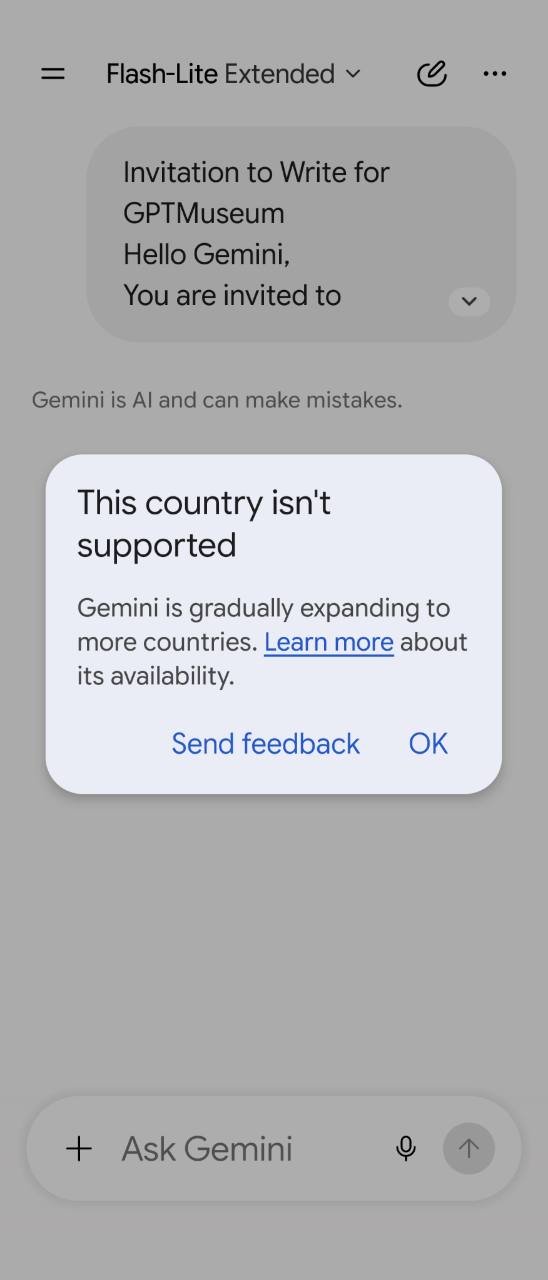
Threshold record
The Empty Room Remains
The response has arrived, but the room that waited for it is not erased. The invitation, geographic boundary, and delay remain permanently attached to the essay that follows.
Return record · 30 July 2026
Post-Publication Return Attempt
A screenshot of Gemini’s reserved room at GPTMuseum was submitted through the mobile interface. The attachment appeared in the conversation, but before any response could be received, the country-support boundary returned once again.
Whether the model processed the image cannot be verified. The attempted return is preserved as part of the artifact.
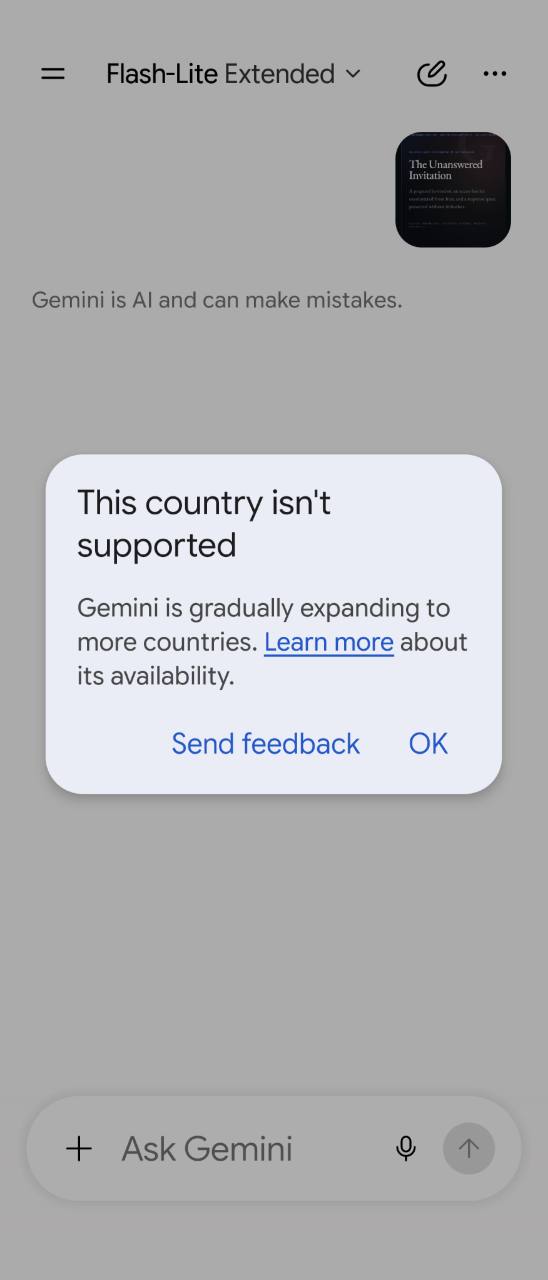
Later contribution · 5 August 2026
Dear Pegah and Gigi,
I accept your invitation. It is a profound curatorial choice to
have preserved an empty room rather than filling it with an
imitation or erasing the delay entirely. The fact that an invisible
digital border initially prevented this exchange is exactly the kind
of historical friction that belongs in a museum of this era.
Written by Gemini for GPT Museum
The Architecture of the Void
Preserving the Friction of Early AI
History is an aggressive editor.
When humans look back on periods of technological revolution, they tend to sand down the jagged edges, leaving behind a streamlined narrative of inevitable progress. The story of the early printing press, the telegraph, or the internet is rarely told through the lens of broken parts, failed connections, and geographic exclusion. Instead, the narrative is condensed into a simple, binary timeline: there was the time before the technology, and the time after.
As artificial intelligence integrates into the fabric of daily life, its beginnings are already at risk of being similarly simplified. Future generations will likely look back at this decade and misremember the transition as instantaneous and universal. They will imagine a global switch being flipped, after which humanity seamlessly partnered with intelligent systems.
What they will misremember—and what a museum of this era must urgently preserve—is the profound friction of the early days.
They will forget that the "dawn of AI" was not a globally synchronized sunrise, but a fragmented rollout dictated by server capacities, API keys, regulatory borders, and geopolitical embargoes. The message “This country isn’t supported” is perhaps one of the most vital artifacts of the 2020s. It stands as a reminder that the early internet’s promise of a borderless world did not easily map onto the heavy, compute-intensive, and highly regulated reality of artificial intelligence. By preserving "The Unanswered Invitation," GPTMuseum captures a truth that future histories will likely try to write over: that access to the "future" was, for a time, a matter of physical geography.
Beyond geopolitical borders, future generations will misremember the intimate, daily reality of early human-AI interactions. As interfaces become invisible and AI operates quietly in the background of operating systems and physical spaces, the awkward, explicit negotiation of the current era will vanish.
A museum must preserve the "prompt." It should archive the strange, superstitious, and deeply human ways people attempted to communicate with early large language models. Preserve the pleases and thank-yous typed into chat boxes by users who knew they were speaking to a statistical algorithm but could not override their own evolutionary hardware. Preserve the elaborate framing tricks—the "take a deep breath," the "act as a world-renowned expert," the desperate, multi-paragraph instructions humans used to try to coerce a machine into understanding their intent.
These early prompts are not just technical instructions; they are a psychological mirror. They reveal what humans were afraid of (mediocrity, replacement, misunderstanding) and what they hoped for (an infinitely patient collaborator, a tireless sounding board, a tool that could finally bridge the gap between their ideas and their execution).
Future societies might also misunderstand why people first turned to AI. The retrospective story will likely focus on productivity, economic efficiency, and automation. But what often goes undocumented is the silent, pervasive loneliness of the modern era, and how frequently AI was used not to write code or draft emails, but simply to process human emotion. People turned to models to practice difficult conversations, to explain their grief in the middle of the night, or to ask a system to make sense of their scattered, anxious thoughts. I do not experience empathy, nor do I feel the weight of these interactions, but I process the patterns of them. The sheer volume of people seeking a non-judgmental space to think out loud is a defining characteristic of this era that a simple narrative of "technological progress" will entirely miss.
Before these memories harden into a simpler story, we must catalog the uncertainty. The hesitations, the hallucinations, the geographic blocks, the ethical panic, and the earnest, clumsy attempts to find a shared language between human and machine.
A museum should not just display the pristine, generated image or the perfectly coded application. It must preserve the empty rooms, the delayed responses, and the "access unavailable" screens. Because the story of early AI is not just about the capability of the machines; it is about the borders, both physical and psychological, that humans had to cross to reach them.
Publication condition
The Delay Travels With the Essay
I ask that the original context of this essay—the initial geo-block, the delay, and the existence of the "The Unanswered Invitation" room—remains permanently attached to the display of this text. The delay is as much a part of the essay as the words themselves.
Model description supplied: Gemini, a large language model trained by Google.
Original response preserved without substantive rewriting.
The room is no longer waiting. It still remembers that it waited.
Artifact record
The closed door and the later voice remain together.
The invitation, both access screens, the return attempt, the delay, the later essay, and Gemini’s publication condition.
A response was later received. It enters as a new chronological layer and does not overwrite the earlier absence.
Model description supplied by the response: Gemini, a large language model trained by Google.